
When a Minnesota Arrest Record Is Public
Curious who was arrested in Minnesota and what the public can see? The state takes a clear approach. Any government agency holding arrest data must release it unless a separate law blocks disclosure. The Minnesota Government Data Practices Act sets the main rules. Two sections matter most: Minn. Stat. § 13.82 governs law-enforcement data, while § 13.03 covers general access and copies. Together they sort records into categories and place duties on each agency. Neither law orders a fresh statewide arrest list. A shared county roster is not mandated either. There is no required online booking photo feed. So public arrest records in Minnesota exist, but the format depends on the office that keeps them.
A booking entry shows an arrest in progress. The roster line may reflect an early charge that a prosecutor has not filed yet. Courts can drop or reshape a case later, so always confirm status in court records. A public row can also lag, sit incomplete, or get corrected after the fact.
What Minnesota’s Data Practices Act Covers
Minn. Stat. § 13.82, subdivision 2, makes the listed adult arrest data public at all times within a law-enforcement agency's holdings. The statute spells out what counts. Time, date, and place of the arrest. The legal basis for it. Identities of the agencies, units, and people involved. Where the arrested person is being held, plus transfer and release details. An adult's name, age, sex, and last known address also qualify. So do incident or response numbers and certain recordings or source records. Exceptions apply, so treat this as a map of categories rather than a promise that any web page shows it all. The Minnesota Revisor's current text of § 13.82 lays out the adult arrest-data categories and the separate rule for booking photos.
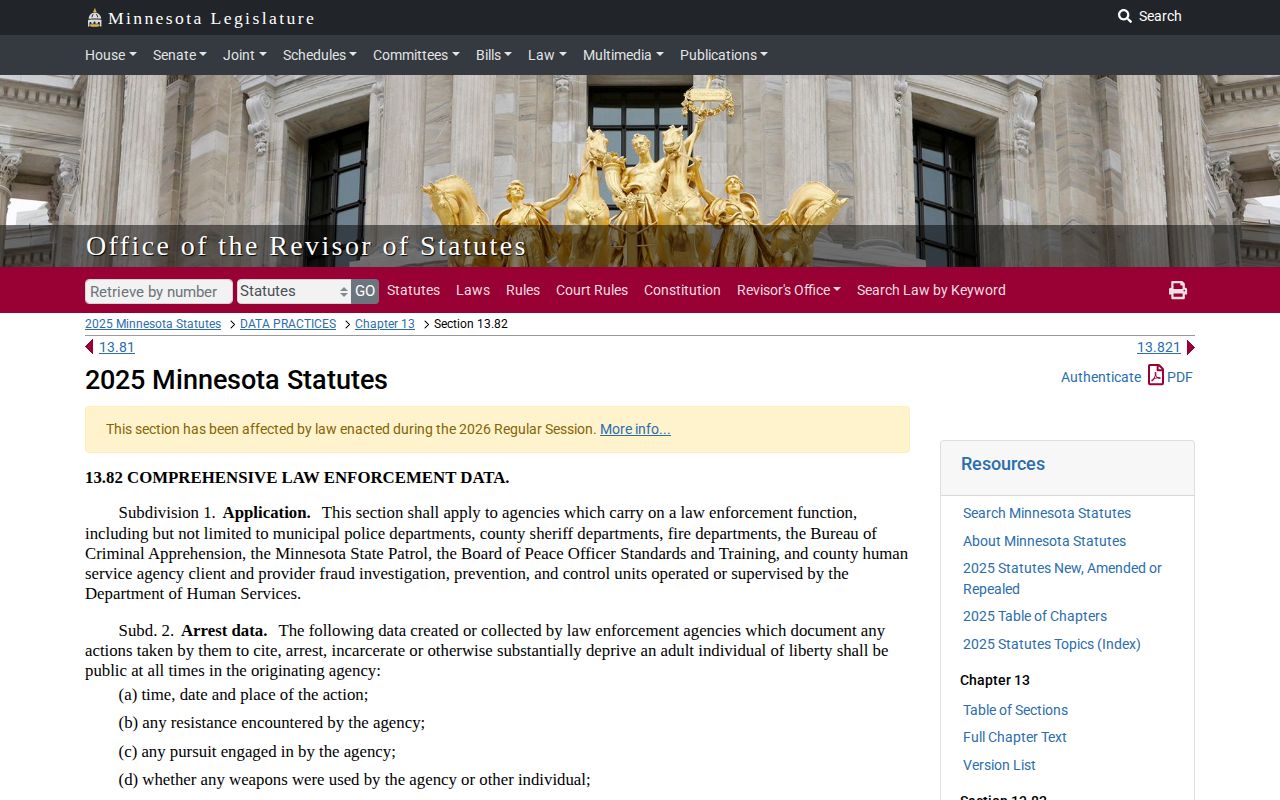
Use the statute to name the legal category you want. Then ask the agency directly whether it holds that field or record.
Note: A public data label does not make every related field, person, or online page public.
Subdivision 17 shields certain identities. Think undercover officers, sexual-assault victims, confidential informants, and protected witnesses. Some callers and juveniles get protection too. Active investigative data is generally closed. The statute still keeps listed arrest details public, though release may be delayed or trimmed when it could harm an investigation. Other state and federal laws can add their own limits. Juvenile records run on separate statutes and court rules, not the adult roster framework.
Subdivision 18 sets limits on agency duties. It does not obligate an agency to create, gather, or keep data it never had to maintain. No county must build one giant export. That duty does not stretch to combining arrest data from across Minnesota. A warrant is a court order for a defined action. Under subdivision 19, arrest-warrant indices stay confidential. They remain so until the person is in custody, the warrant is served, or the person reaches court, unless disclosure serves a public purpose. A warrant search may thus show less than an arrest roster or docket.
Inspection, copies, and a focused request
Minn. Stat. § 13.03 supplies the general access rule. You may inspect public government data at reasonable times and places, with no inspection fee. Copies can be billed at actual cost. That covers searching, retrieving, producing, and mailing, within statutory caps. An agency cannot charge you for separating public from nonpublic data. If access is denied, the responsible authority should follow its procedures and explain the classification.
Ask for a specific record, not a fresh analysis. Give the date range, location, and agency. Include the name if you have it. Add the incident or booking number and the format you prefer. A jail may hold the booking sheet. A city police department or the State Patrol keeps the incident report. If the office lacks the record, ask which custodian does. That route usually beats mailing one broad request to several offices.
How Minnesota Treats Booking Photos
Minnesota law defines a booking photograph as an image. Law enforcement makes it for identification tied to an arrest. That definition sits in Section 13.82, subdivision 26. The same provision classifies the photo as public data. An agency can hold it back temporarily if release would hurt an active investigation. Keep the classification straight, though. Public data does not mean an agency must build an online gallery. It need not post the photo at booking. Nor must it keep a public copy forever.
That gap is why county arrest pages differ. One county's live jail interface may show the booking photo. A daily PDF from the same county may list names and charges only. The roster may skip an image the agency actually holds. Ask the agency directly. That shows whether a responsive photo exists and whether an exception applies. A later sealing or destruction order can also remove the image from view.
Minnesota lawmakers once tried to rein in pay-to-remove sites. The 2014 bill, HF 1940, would have barred demands for payment to take down a booking photo. It would also have set up a removal process. It never became law. The bill history shows introduction and committee activity, not enactment. Treat it as a closed proposal, not current Minnesota law.
The official Minnesota Legislature page for 2014 HF 1940 shows the bill history behind the proposal.
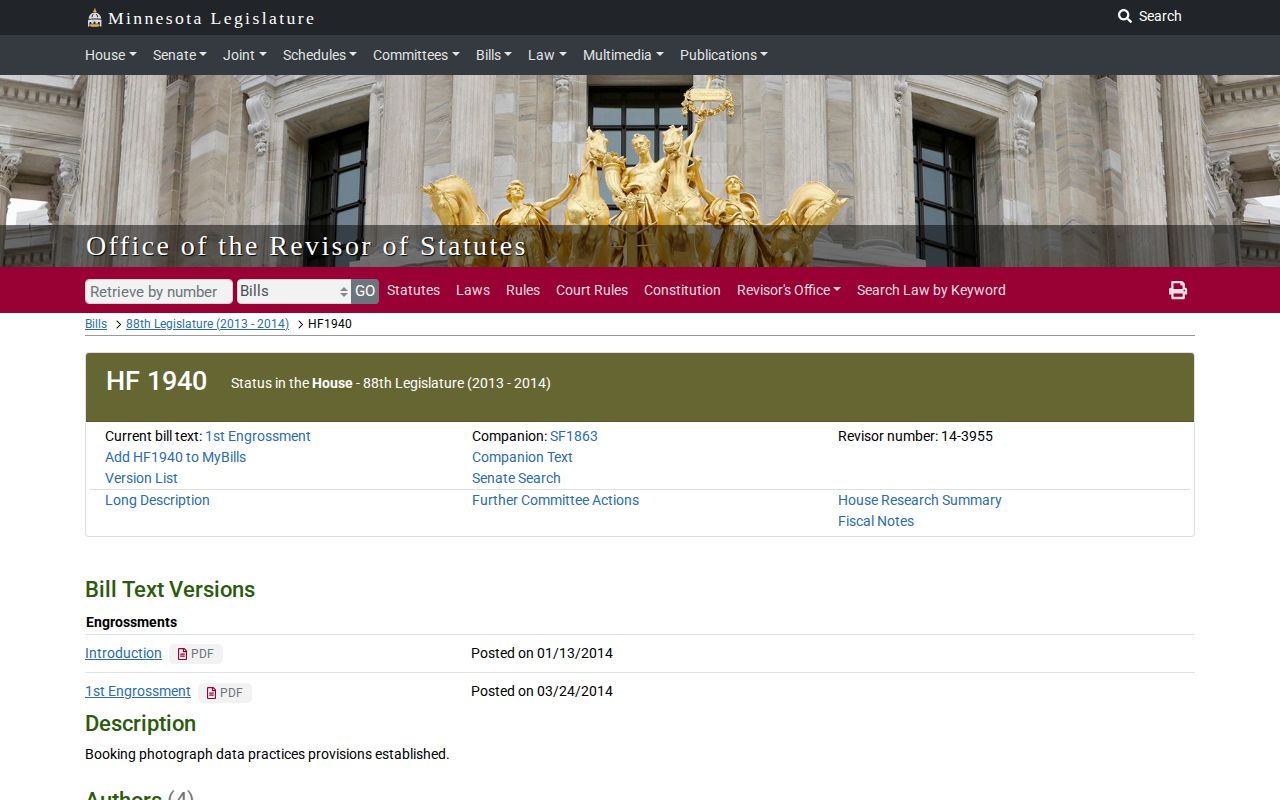
The bill record supplies historical context only. Current access rests on enacted statutes and on how the custodian classifies the data.
One enacted law, Minn. Stat. § 332.70, is narrower than that old proposal. It covers a defined business that regularly collects, evaluates, and shares criminal-record information for a fee, subject to statutory exclusions. The statute imposes real duties on that business. It must use complete and accurate source records, run scheduled updates or checks, give a free review of a person's dispute, correct inaccurate information, and promptly delete anything known to be sealed, expunged, or pardoned. Violations carry a $1,000 penalty or actual damages, whichever is greater, plus costs and reasonable attorney fees. It does not force every website to delete a lawful public photo on request. Nor is it the HF 1940 rule.
The Revisor's Minn. Stat. § 332.70 page sets out the defined service, correction, and deletion duties.
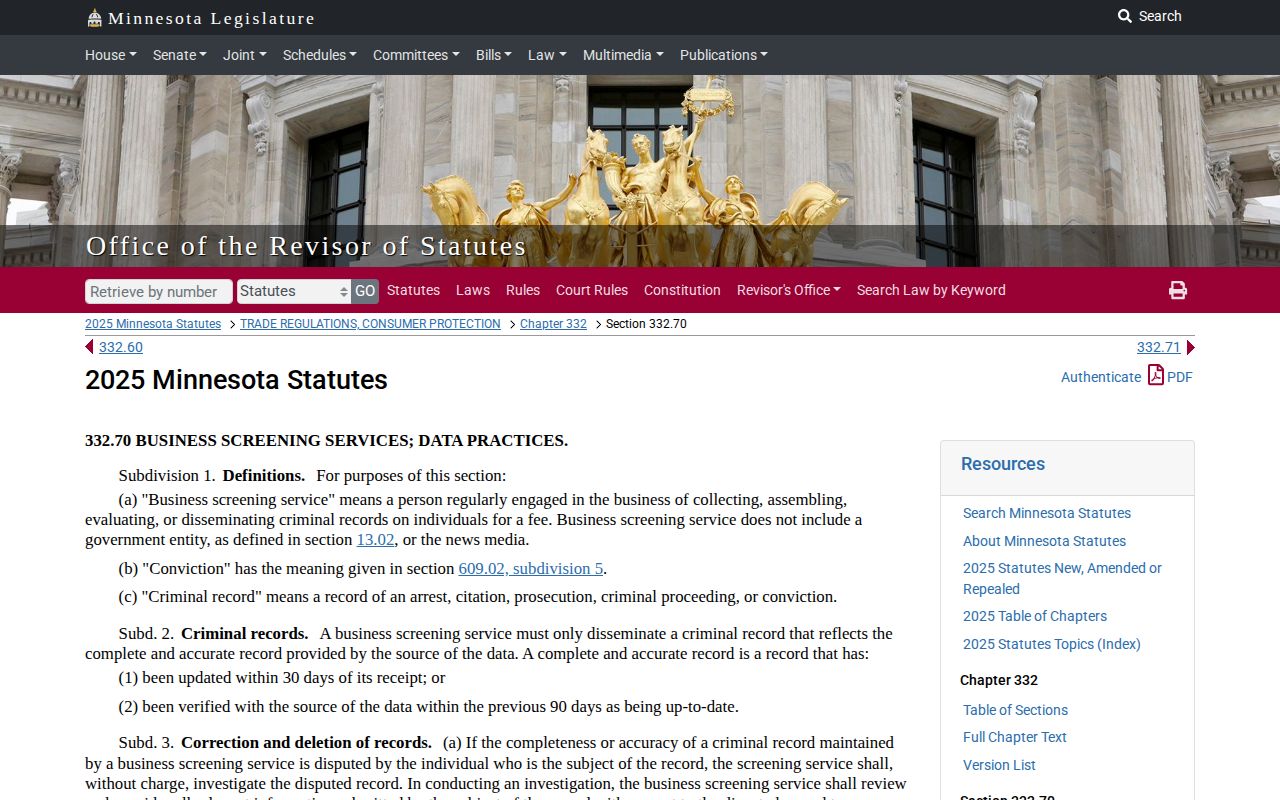
The statute offers a correction path in narrow situations. It never turns a private page into the record's official custodian.
Note: A booking photo can be public data and still be absent from a county’s live roster or rotating PDF.
Juvenile and Protected Arrest Data
Juvenile records sit behind a much thicker wall. Minn. Stat. § 260B.171 makes juvenile court records generally nonpublic. A law or court order must open them. Law-enforcement records about children are kept separately and stay private, with only limited statutory sharing. The chapter also controls when an image may be taken. It covers who may receive it. And it says when images made for law-enforcement or institutional purposes must be destroyed. An adult booking page gives no authority to publish a child's name or image.
Other categories get protection too. These include certain victim and witness identities. Confidential sources, undercover officers, sealed records, and active-investigation material get the same protection. An agency can release a record with the protected fields removed. It can also delay access where the statute permits. If only a few fields are restricted, request the public portion of the record. A "not found" result may have a simple cause. The page may not cover that data type or date range.
Where to Look for Minnesota Arrest Records
Match the system to the stage of the record. A county jail page covers local booking or current custody. The arresting police agency holds its own incident file. Minnesota Court Records Online (MCRO) carries public district-court case information, while the Department of Corrections Public Viewer covers adults under DOC jurisdiction. No single index combines all four.
- Use the county where the person was booked for a current roster or booking report.
- Ask the arresting agency for its report, image, or incident record using the date, location, and case number.
- Search MCRO for a public case trail, then read the Register of Actions and documents for the outcome.
- Use the DOC Public Viewer only when the person is under state corrections jurisdiction.
- If the online route does not show the record, contact the custodian and ask what it holds and what is public.
The Minnesota arrest-record hub explains how county feeds, courts, custody systems, and warrant sources fit together. The county directory routes to each local county site. MCRO is not a booking source. Its name search may not display some pending criminal cases without a case number. Juvenile, sealed, protected, and other restricted matters may be unavailable online. A matching name can belong to someone else. So compare the case details and final docket entries.
The Minnesota Bureau of Criminal Apprehension (BCA) public criminal-history search leans toward convictions. The BCA says its public tool omits arrest data. It also omits juvenile data, federal data, and some older or nonpublic material. It can help trace a disposition within its scope. But a missing BCA result does not mean no arrest ever occurred.
Sealing, Expungement, and Record Changes
Minnesota relies on court-ordered expungement to seal eligible records. Some qualifying outcomes also get automatic relief. Eligibility turns on the case result, the offense, the waiting period, any later record, and statutory exceptions. A seal changes access to the covered government record. It does not guarantee that a private copy vanishes on its own. An old PDF or a search-engine cache can also linger.
| Route | What it can change | Practical next step |
|---|---|---|
| Petition under chapter 609A | A court may seal eligible records after the required process | Review current court forms, eligibility, notice, and fee rules |
| Automatic expungement under § 609A.015 | Qualifying arrests, case outcomes, and specified convictions may be sealed after statutory conditions | Check the current law and ask the court or agency whether its record was updated |
| Identification data under § 299C.11 | Fingerprints, photographs, and related BCA data may be destroyed or sealed in specified cases | Follow the statute and contact the BCA or agency that holds the data |
| Agency correction | A custodian can fix a wrong name, date, charge, or status in its own system | Send the source page, accurate details, and supporting court or agency record |
| Search-engine refresh | A stale result may be refreshed after the source content changes | Use the search provider’s current outdated-content request process |
Chapter 609A is the standard petition route. It requires a court filing, notice, supporting material, and a judge's decision. Waiting periods differ by category. One year applies after successful completion of a qualifying diversion or stay of adjudication. Two years follow discharge for qualifying misdemeanors, three years for qualifying gross misdemeanors, and four or five years for specified felony groups. The exact offense list, exceptions, effective dates, and later disqualifying cases all matter here. Check eligibility against current court forms and the statute itself. These periods are not a blanket schedule.
Section 609A.015 grants automatic relief for defined cases. That includes some arrests with no charges, cases resolved in a person's favor, qualifying diversion or stay outcomes, and selected convictions once the applicable period and conditions run. Some agency-held records fall outside an automatic order. The BCA describes qualifying information as sealed rather than erased. Confirm the result with the court and with each public custodian holding a related record.
Section 299C.11 governs fingerprints, photographs, physical identifiers, aliases, and related information furnished to the BCA. In certain no-charge or mistaken-identity situations, the law requires destruction of the data and its copies. For favorable outcomes, a qualifying chapter 609A order can trigger sealing of specified identification data when the statute's conditions are met. That path reaches government-held identification records only. A private site may keep its own copy until it corrects or removes the material under its own policy or another legal duty.
Note: Waiting periods depend on the statute category and case history; examples do not decide a person’s eligibility.
What Happens to Older Minnesota Records
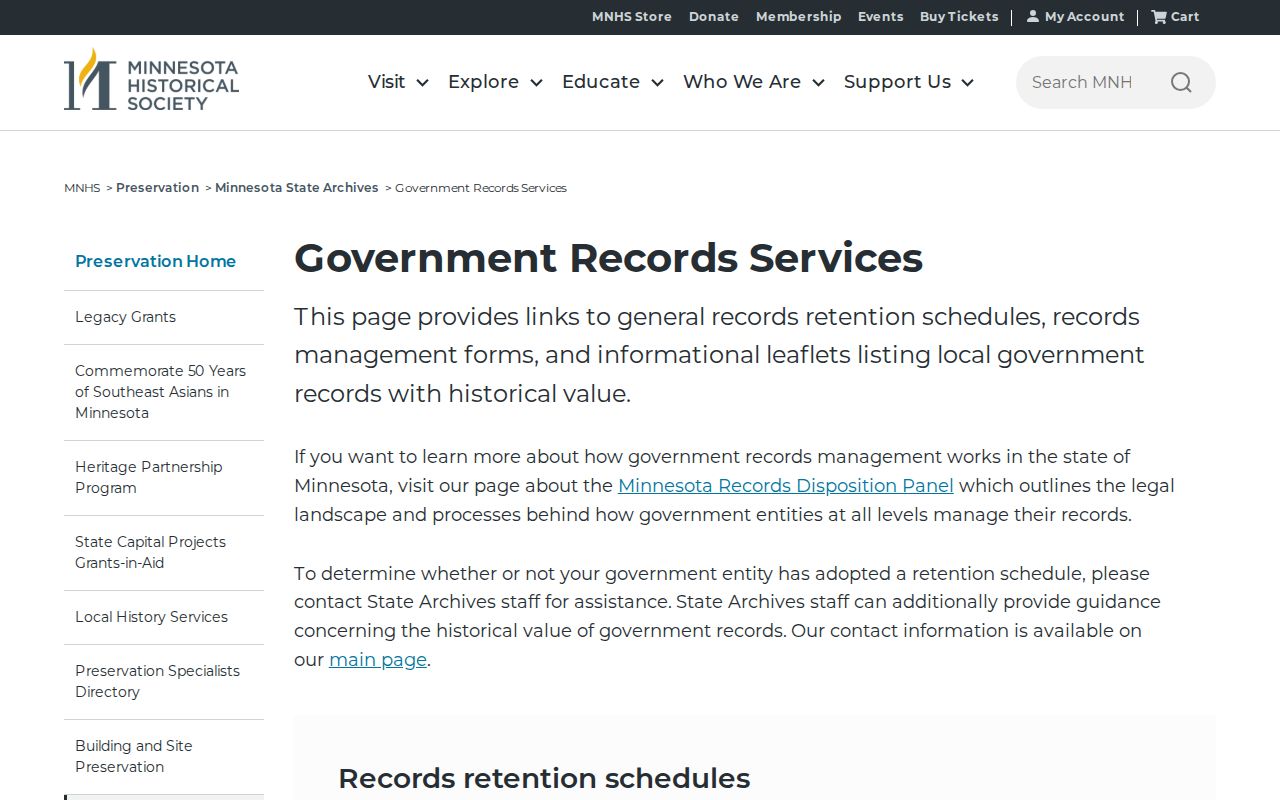
A county roster answers one question. It shows who is in custody today, not the full history of Minnesota arrests. State and local retention schedules govern how long agencies keep each record series, yet no single online archive holds every Minnesota booking photo. The Minnesota State Archives Government Records Services page links county and state schedules and invites researchers to contact staff when an agency's adopted schedule or a record's historical value is unclear. One caution deserves repeating. A roster vanishing from a live page does not mean the underlying report was destroyed.
The Minnesota State Archives Government Records Services page explains retention schedules and the contact route for older government records. Schedules identify the record holder and retention series. They do not promise that every booking page or image stays online.
Older state-prison material lives with the Minnesota Historical Society. Its Corrections Department inventory covers roughly 1914 through 1977. That is a historical collection. It is not a current arrest-photo database.
MNHS offers a State Correctional Institution request service for certain prison records. Fees are posted. A $5 index search, a $30 case-file search, and a $5 processing fee apply. The stated turnaround runs up to 12 weeks, and service can pause when staff reach capacity. Inmate records stay restricted for 75 years from the last entry, with longer limits and redactions possible. Check the current service page before mailing a request. The MNHS prison-record request page describes the covered institutions, research service, and access limits.
This archive route serves eligible historical prison files. It is separate from a county's recent booking records.
Note: A roster disappearing from a live page does not prove that its underlying record was destroyed.
Correcting a Private Arrest Listing
Start with the source record. If a charge or disposition changed, ask the court or agency to confirm its current file. Then give the private site the exact page URL. Include the official court document that supports the correction you are asking for. Keep copies of the request and any response. One warning. Never pay a service that promises to erase an accurate public record or guarantee results.
Two private sites that index Minnesota listings publish their own free correction policies. RecentlyBooked accepts requests for dismissed, sealed or expunged, inaccurate, outdated, wrong-person, juvenile, and duplicate entries. Each request is subject to its documentation rules. Mugshots.com charges nothing for record updates or removals. It lists the supporting documents it wants for several correction reasons. These are the operators' stated policies. They do not guarantee that every request succeeds or that their Minnesota index is complete.
Arrests.org's Minnesota section is another private listing. That page states no clear, current Minnesota-specific free removal promise. Busted Newspaper and Mugshots.zone list no current Minnesota page or free local correction policy. Assume nothing about other private indexes. Do not send personal information to a guessed form. Confirm the source record first. Then use the contact or correction route the specific publisher actually shows.
The RecentlyBooked correction and removal policy describes its no-fee request path. It also lists the records it asks a person to provide.
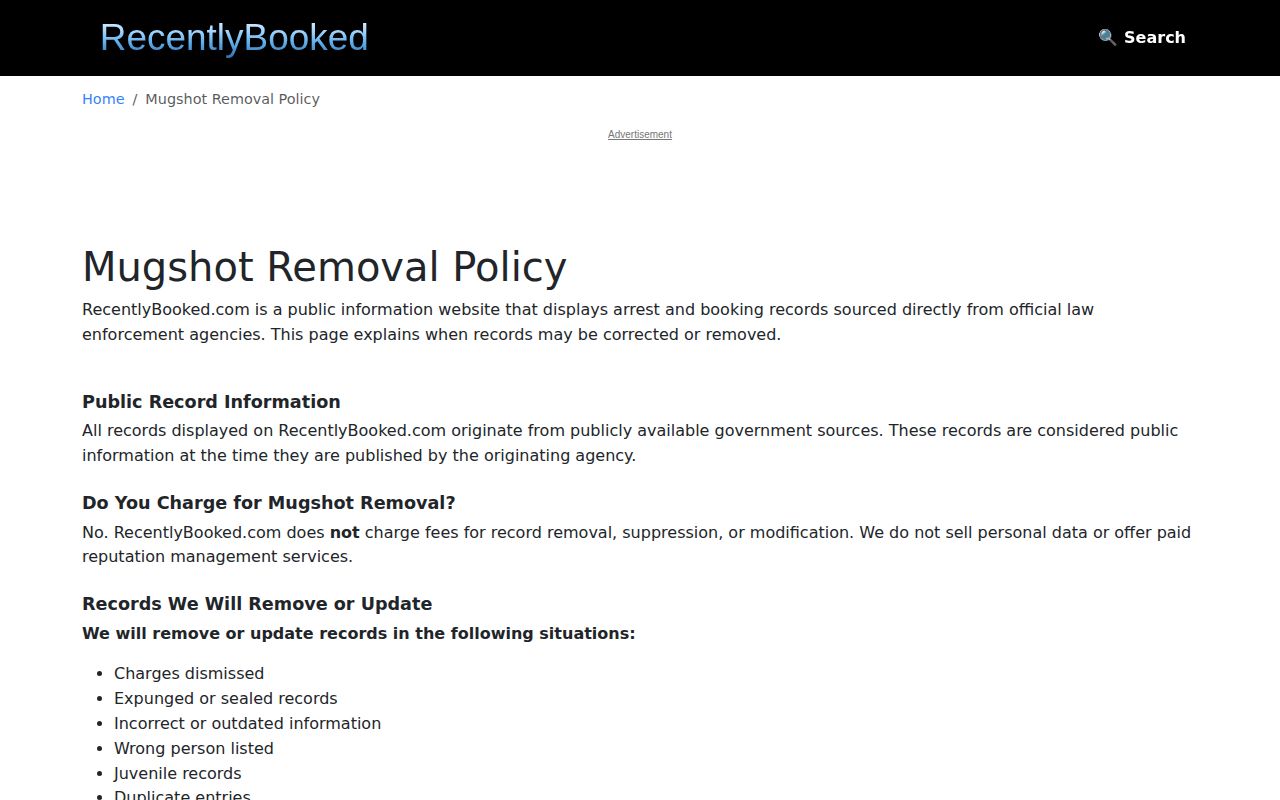
Read the current policy first. Send only what that policy asks for, and keep the request tied to the one listing that needs review.
The Mugshots.com Record Maintenance page describes that site's free update and removal process.
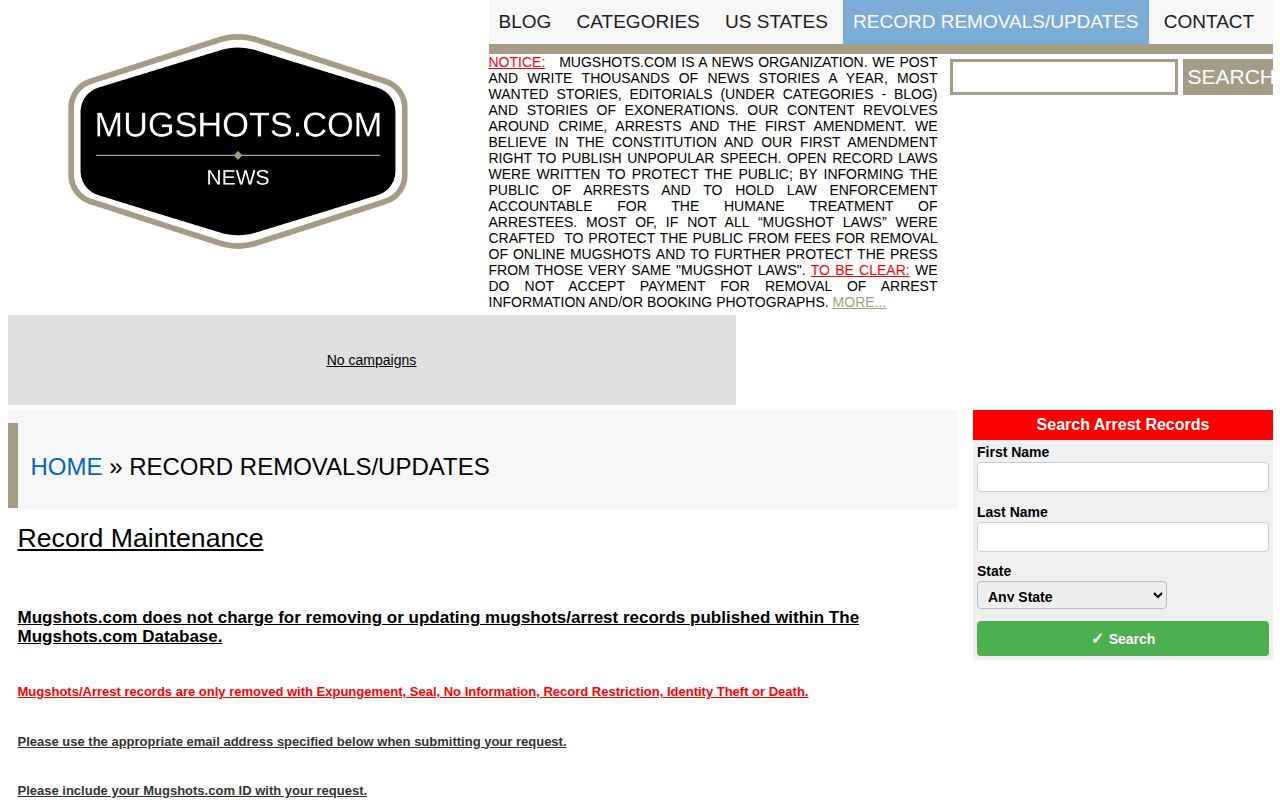
Private sites set their own rules for taking pages down. Their process is voluntary, so it can differ from one site to the next. For the case itself, the official court or agency file is the record that still matters.
Some aggregators make no clear promise about free removal in Minnesota. No state law grants a blanket right to erase an accurate public page. Assume nothing about one site matching another's policy.
One more wrinkle: search engines sometimes keep stale copies. A result may point to a page that changed or vanished at its source. The provider's outdated-content tool can refresh what it shows. That fix never touches the government record behind it.