
Minnesota VINE County Jail Coverage
The Minnesota Department of Public Safety runs VINE through its Office of Justice Programs. The DPS Minnesota VINE page holds the state search link and a phone route. A DPS fact sheet spells out the basics. The service is free and anonymous. It runs 24 hours a day, 365 days a year, and tracks people held in Minnesota county jails and detention facilities. When a custody record changes, registered users get notified. That suits one question after an arrest: is the person still in county custody? It was never built to gather every Minnesota arrest into one feed.
County jail systems send records on a regular cycle, usually every 15 or 30 minutes. That pace is not a guarantee. A booking number may not exist yet. Someone may be released before the feed catches up. The arresting agency might also book a person in a different county. VINE reports only the custody data supplied to it.
County coverage is documented unevenly. Official pages in Aitkin, Becker, Beltrami, Cass, Chippewa, Chisago, and Crow Wing link to VINE or tell visitors to try it. Many other counties post no VINE page of their own. That gap does not mean the jail is absent from the service.
The official Minnesota VINELink landing screen shows the state entry point.

Think of it as a doorway. A custody check starts here, but the screen is not a map of which county systems are connected.
Check a Minnesota Arrest
VINELink works best for one person at a time. Search after an arrest by name or ID number. The fact sheet allows partial names too. An ID narrows things quickly. Without one, compare each result carefully before deciding it belongs to the person you seek.
- Open the Minnesota person search or follow the state entry link from DPS.
- Search by the person's name or identification number. A partial name can help when spelling is not certain, but it may return more than one record.
- Open a possible match and compare the facility, booking or facility ID, and other non-sensitive details shown by the service.
- If the result points to a different county, use that county's own jail source to confirm the custody record and its latest status.
The blank Minnesota person-search form is the entry screen used to begin a check.
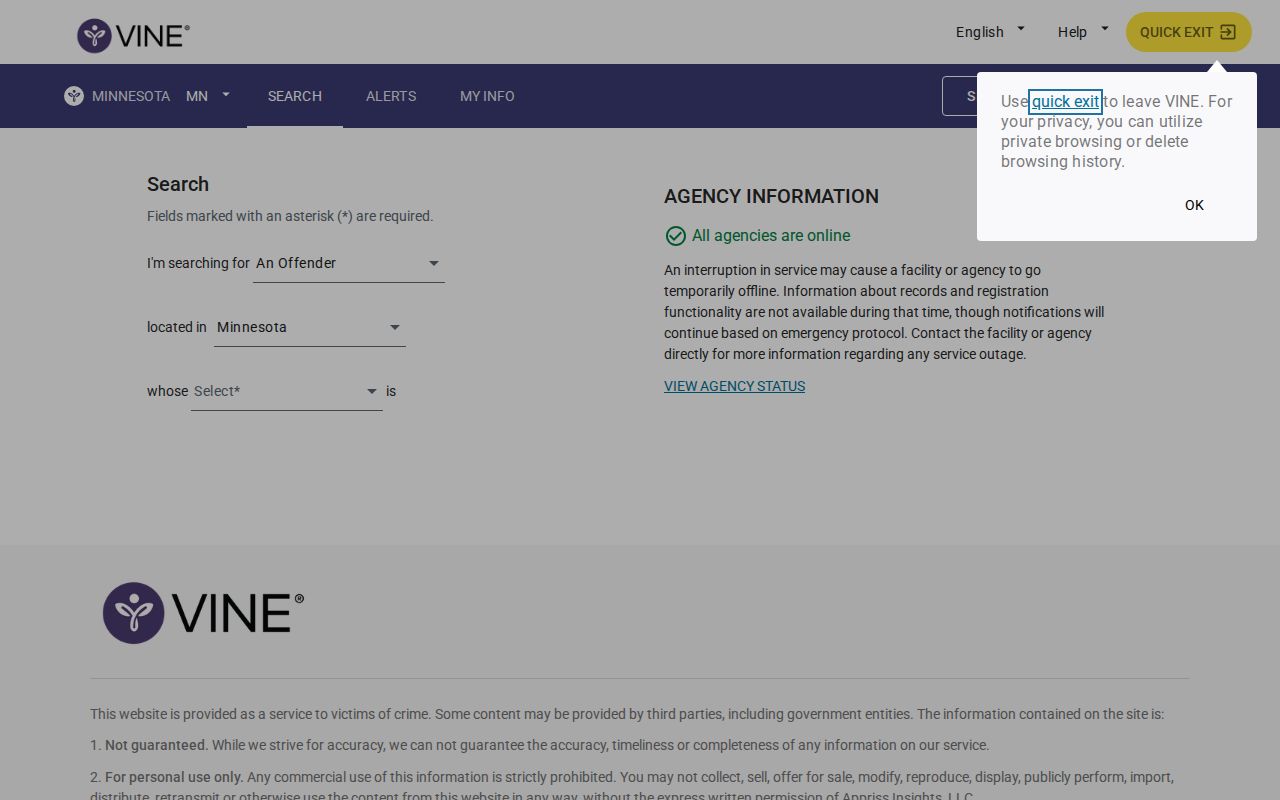
An empty form shows no one. A live match still needs a close look. This matters with common names or an unknown booking county. The arrest county and the current facility can differ. Another county may take the booking, and a later transfer can move the person again. Treat the VINE facility as current custody. Then ask the arresting agency for its own arrest record.
Minnesota VINELink Result Fields
A VINE result reflects what the service held at the time of the search. Fields vary by record and feed. A blank value means unavailable, not that an event never happened.
| Field | What it can show |
|---|---|
| Name | The name attached to a possible custody record; compare more than the name when matches repeat. |
| Identification number | An offender or facility identification number that can help distinguish records. |
| Custody status | The status sent by the participating jail system when the result is viewed. |
| Facility | The county jail or detention facility shown as holding the person. |
| Booking information | Available booking details, including the facility identification number. |
| Scheduled release | A planned release date or time if the source record supplies one. |
VINELink is a status and alert service, not a booking-photo gallery. A result may lack a photo or full charge list. Court filings stay out as well. Turn to the county booking record for arrest and booking details, and to the court record for case events and the final outcome.
Note: VINE fields depend on the data sent by a county system, so one county's result may be fuller than another's.
Verify a Minnesota VINE Match
A name match is only a lead. Read the facility and booking identifiers side by side. Compare age or other non-sensitive identifiers only when the official result shows them. Check the county the source names. The jail is not always the place where the arrest happened. One name can belong to more than one person, and one person can have records in several counties. Reopen the official result for current status. If the facility conflicts with what family, an attorney, or an agency expects, call the listed jail to confirm.
Register Minnesota VINE Alerts
Registration ties a contact method to the custody record. VINE then sends notice of covered events. A phone number or email address works. The fact sheet says each registrant creates a personal identification number, or PIN, for the service. A VINELink account is optional, and no name is required to create one.
- Find and open the correct Minnesota custody record before choosing an alert. Check the facility and ID first.
- Choose phone or email as the contact route and follow the prompts for release, transfer, or other available custody-change alerts.
- Create and keep the PIN requested by the service. Phone notices use it to confirm that the intended recipient received the message.
- Use VINELink or the phone service with the PIN to change or cancel a registration when it is no longer needed.
The statewide VINE line is 877-664-8463. For a lost PIN, the fact sheet lists 866-277-7477 for the Customer First Center. Guard the PIN. It confirms phone notices and changes a registration. Phone support covers English, Spanish, Hmong, and Somali, with a live operator and language line at all hours. Multilingual VINELink access is also listed, so follow the current service prompts.
Minnesota VINE Alert Timing
VINE sends several kinds of custody alerts. A registrant can hear about a general release, release on a court order, release on bond, or an escape. A record purge also triggers a notice once the record leaves the service. Bond, in this setting, means a release amount or condition set by a court. Some events carry a non-emergency or delayed label. That group includes unsupervised custody, an outage, a transfer, and a death. These labels govern how the service handles a notice. They do not put every event on the same delivery schedule.
Phone alerts work on a repeating loop. Normal calls repeat every 30 minutes for 24 hours until the recipient enters a PIN. Answer without the PIN, and later calls may arrive every two hours instead. Non-emergency calls stay inside the documented 7 a.m. to 9 p.m. window. Text, email, and in-app notices generally send once rather than looping like a call.
Two delays are built into the protocol. Transfer notices wait eight hours after VINE receives the discharge record. Death notices wait 12 hours so family can be notified first. The service documents these timing rules. It cannot promise the originating jail has already sent its latest booking or release data.
Note: Alert timing begins with the information VINE receives, so a notice may follow the underlying custody event.
Minnesota VINE and Haven
Minnesota VINE covers county jails, not Department of Corrections facilities. Once an adult is sentenced to DOC custody, the DOC keeps its authority. That covers prison time or supervision. The MN DOC Public Viewer becomes the separate public search for available custody and supervision information. Photos depend on the profile. The viewer promises no photo for every person.
Minnesota Haven is the DOC's own notification route for custody and release events. You register through a form sent to DOC Victim Assistance. The DOC page describes email or mail notices. Phone notification is the exception. It is generally held for an escape from a Minnesota correctional facility. That is a different enrollment path and a different custody layer than county-jail VINE. The official Haven page lays out the DOC route.
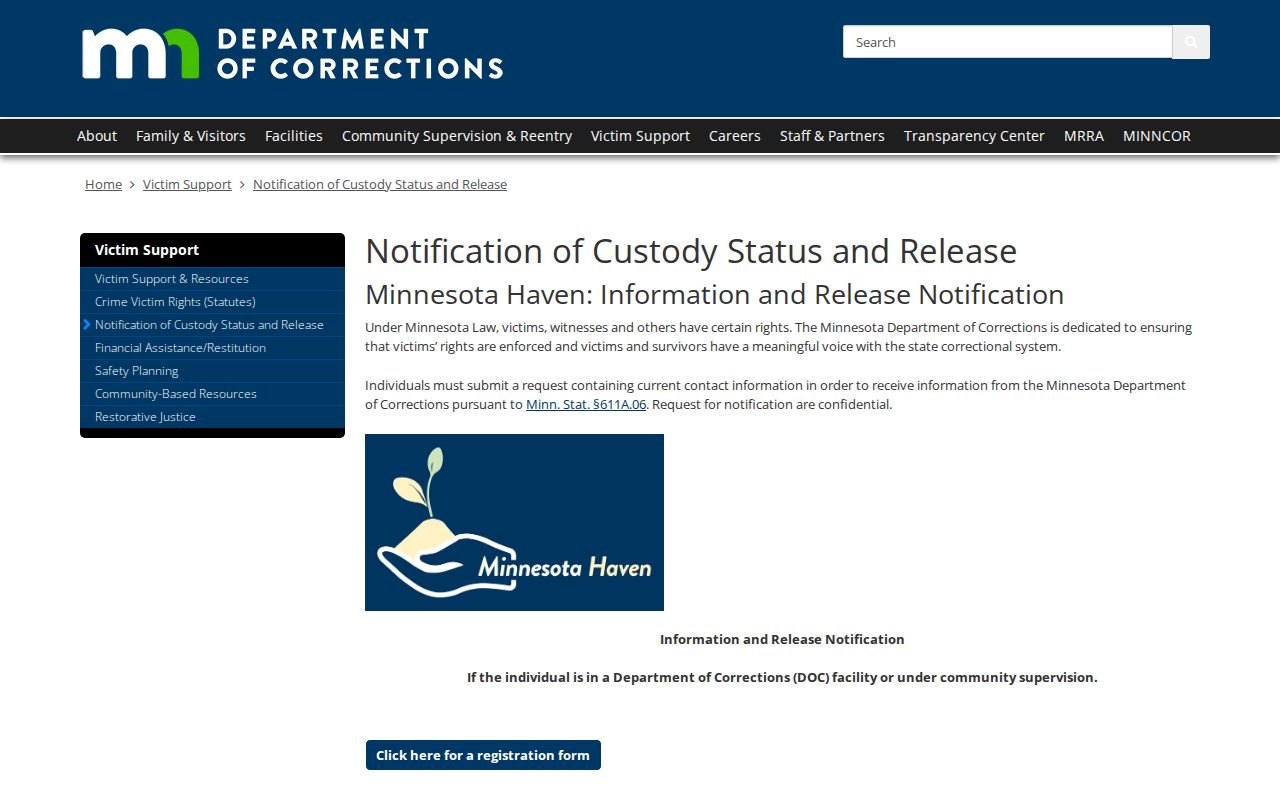
The image shows the state corrections notification path. It is not a second Minnesota VINE search or a county booking feed.
| Custody layer | Official route | Use it for |
|---|---|---|
| Minnesota county jail | Minnesota VINE / VINELink | Custody status and county-jail release or transfer notices. |
| State prison or supervision | Minnesota Haven; MN DOC Public Viewer | DOC custody or supervision information and separate notification registration. |
| Federal prison | Federal Bureau of Prisons (BOP) Inmate Locator | Federal prison custody, not a county arrest or photo feed. |
| Federal immigration custody | U.S. Immigration and Customs Enforcement (ICE) detainee locator | ICE custody, using the identity details requested by that system. |
VINE sends no alerts for BOP or ICE custody. A transfer out of a county jail can end the Minnesota VINE trail even when the person remains in custody elsewhere.
Minnesota VINE Limits and Fallbacks
VINE is a custody-status and notification service. It is not a historical booking archive. Nor is it a court-disposition portal, warrant index, or statewide booking-photo gallery. A fresh county booking can be missing while the jail processes it. It can also lag before the next data transmission. Someone released quickly may never appear the way a person held through an update does. A blank match can also reflect a transfer. It may also stem from a search error, a data-entry issue, or a different county custodian. Juvenile, sealed, protected, DOC, BOP, and ICE records all sit outside the ordinary county-jail search.
No match? Check the likely county's official roster or newest booking report. Then contact that county jail or the arresting agency. Ask a narrow custody or booking-record question. The statewide same-day arrest view explains why fresh booking lists can lag. The Minnesota County Directory helps you find the county's own source. An arrest can happen in one county while the person sits in another county's facility. Check both agencies instead of treating one empty search as final.
State Patrol incident records are a separate layer. Crash Updates and the incident search cover selected traffic incidents, not a complete arrest roster. For a likely highway arrest, check VINE and the receiving county's jail source. Custody details can fall short. Then ask the State Patrol or the originating agency for an incident record.
Each custody type has its own fallback. For someone under DOC jurisdiction, check the Public Viewer and ask about Minnesota Haven. For federal custody, use the BOP or ICE route. For a criminal case outcome, turn to Minnesota Court Records Online (MCRO) or the court clerk. MCRO is not the booking source. Some pending cases without convictions require a case number for online name access, and protected records may not appear.
When records conflict, ask the originating jail or agency which system holds the current record and what data it can release. An absent VINE result is a reason to verify with that custodian. It is not proof that no arrest occurred.
Note: A released person may leave the current roster while the arresting agency still holds a booking record or report.